
On May 18, 2026, the Zinn Education Project hosted an end-of-year showcase for the 2025–2026 cohort of Teaching for Black Lives study groups with special guest, Dr. Bettina Love, award-winning author, abolitionist, and professor.
Rethinking Schools editor Jesse Hagopian facilitated a conversation with Dr. Love on why it matters for teachers, authors, and librarians to bring liberatory education practices into the classroom — and why the work the study groups have done all year is so appreciated. Dr. Love said,
This is exactly what educators should be doing right now. You are gearing up, you are getting the muscles, you are getting the strength, so when the pendulum of justice swings back, you’re ready. If you stay ready, you ain’t got to get ready.
The conversation was followed by a panel of coordinators — Gabriela Guzman, High School Social Studies Teacher in Montclair, New Jersey; Laurel Dias, Utah Valley University Associate Professor; and Caitlin Pankau, Union Staff Liaison for the Idaho Educators Association — sharing highlights of their study group experience.
The discussions that we’ve had this year about Black history in the curriculum and the racial equity issues in our district, helped us to plan the lesson activities for the Black Lives Matter at School Week of Action. — Gabriela Guzman
Beyond just reading the book, I’m able to connect and learn more about what my colleagues have done, their experiences with these topics, and grow together as a study group. — Laurel Dias
The study group reminded me that this work is not only academic, but it’s deeply personal and rooted in relationships, identity, and lived experience. — Caitlin Pankau
Watch the recording below.
Transcript
Bettina Love: What’s up, everybody? It’s really wonderful to be here. Jesse, thank you so much for that beautiful introduction, and thank you so much for the work that you do. And to everybody on this call, just thank you, thank you, thank you. Writing books is a lonely task, and so when you know that people are reading the book and engaging with the book, it is the biggest compliment you could have. So, I just want to say thank you to everyone. I salute everyone. I know we’re all doing this work in our own way, and I’m just really grateful to be here with you tonight. So thank you, thank you, thank you, thank you.
Jesse Hagopian (he/him): Every year for the last five years we’ve had between 50 and 100 study groups across the country reading Teaching for Black Lives, and then often picking up other texts in subsequent years afterwards, and it’s been incredible that even in places where there are laws that are trying to ban teaching for Black lives, these educators are rising to the task. So I wanted to start by saying that for so many of us in the Teaching for Black Lives study group, your work has really helped us imagine education, not just as instruction, but as sites of healing, struggle, and transformation. And looking back on your journey from your book, We Want to Do More Than Survive, to your more recent book, Punished for Dreaming, what do you feel educators most urgently need to understand right now about what Black children are owed, and what it truly means to teach towards freedom?
Love: I think I see your book in the background, Teach Truth, and that’s really what this is about right now. We are in a moment right now where we need to understand that if you tell the truth, that is the absolute cost of love right now. If I love you, I’m going to tell you the truth. If I love you, I’m going to give you an education that is going to help free you. If I love you. Now, if I pity you and I look down on you, and I’m just there because I want to collect a check, or I really don’t understand why I’m there, then I don’t get it. But it is a moment right now where we have to teach the truth. And the reason I say that is because I study policy, and we want to do more than survive. And what I know about policy is that you just need a good story. Policy isn’t created because people tell the truth, policy is created because people are up there just freestyling. So, if we tell the truth we can create policy. I think at moments like this, where it seems so dire, the stakes seem so high, and we don’t know what to do, I think it’s a very simple thing to do: Tell the damn truth. Learn the truth and tell the truth. And that is the highest form of love you can give anybody, to tell them the truth. You can tell it with kindness, you can tell it with compassion, but our job as educators is to tell the truth.
Hagopian: Let’s do it. Yes, there’s a lot of love happening in the chat, and from everyone here. I know people are feeling that. So I wanted to talk to you about the people we have on this call with us this evening, because this gathering is filled with educators who have spent the year studying together, wrestling with history, sharing classroom practice, and trying to build spaces rooted in abolitionist teaching and in freedom dreaming, and in a time when teachers are increasingly isolated and censored and under attack. What’s the significance of educators coming together in these Teaching for Black Lives study groups? What do you think becomes possible when teachers learn, organize, and struggle collectively?
Love: bell hooks says it best, and there’s so many people that say this, that nothing can be done that’s not in community. It has to be in community. Working in silos, working in isolation . . . first of all, you believe your own hype. That’s the first problem of working in silos: You believe your own hype. I’ve had people come up to me, like, “Dr. Love, I’m a co-conspirator.” And literally, the people behind them are like, “Chill with that.” So, I think, first and foremost, it gives you an opportunity to try out these ideas. Like, we’re all talking ideas, ideas, ideas, but at the end of the day, you’ve got to do it. At the end of the day, you’ve got to try these things out. At the end of the day, you have to try and live this practice. And it is hard to do. So when we come together in study groups like this, it’s an opportunity to try to live these things out. And that’s really what this is about.
Like Robin D. G. Kelley says, if the work doesn’t leave you transformed, then what’s the point? What’s the point if you’ve been in this study group all this time, and you’re still the same teacher? What’s the point every day trying to be transformed, every day trying to understand that we’re going to fumble? Using Mariame Kaba’s language, we fumble through this, we stumble through this, but we pick the ball back up. And so being in study groups allows us to explore and experiment and be in conversation and be in community with these ideas. That’s what learning, that’s what love, that’s what justice is all about. And you’re not going to get it right. You’ve got to give yourself grace. Other folks, you’ve got to give yourself grace. It is this dialect, right?
I think people hear a study group and they’re like, “Oh, another study group? No.” But I think the way you all are doing it, with so much intention, so much love, it is about saying, “How do we transform ourselves first?”. As my grandmother would say, “Sweep outside your own front door.” So how do you understand yourself first? And then after that, you move into these spaces with other people, and you realize . . . I mean, I didn’t know I should be thinking that. And you start to understand the world, and people, and different ideas, and how folks are taking up the work in their own lives, and how you take up the work in your own lives. So I think it’s such a powerful space because I think white supremacy culture tells us we have to move mountains for justice. And that’s not true. The biggest thing you can do is with the people that you are building with, with the people that you love, the people that are in your house, the people that are in your study group. That’s how we move this thing: We move it person by person, group by group, community by community. And so what you all are doing is absolutely gorgeous in the grand scheme of the ideas of justice.
Hagopian: No doubt. I mean, it’s been incredible to see some of the victories these groups have had, whether it’s from teaching more accurate history in the classroom, or it’s organizing for the Black Lives Matter at School Week of Action or the Teach Truth Day of Action, or it’s winning restorative justice programs and replacing zero tolerance discipline in their schools, or fighting and winning more Black Studies programs. I mean, some of the work these educators have done is truly profound. And you’re right, it’s about that collective struggle that made all those things possible. And I want to pick up on that, because you wrote an essay recently for Education Week called ‘There Are No Heroes Coming to Save Us’: Black History Without the Hero Worship. So I wanted to ask you about that, because you argue that too often we teach Black history through individual heroes instead of collective struggle. How does that argument change the way we should think about the role of education in this political moment, at a time of rising authoritarianism and attacks on truth-telling and growing repression? What does it mean to help students understand that there are no heroes coming to save us, just us, and we are enough? And what are the roles of educators in helping young people see themselves as part of this larger tradition of collective struggle and freedom dreaming?
Love: I think that’s the word that you just used now, tradition. It is a tradition. And I think when we talk about a King or we talk about a Rosa, or we talk about a Harriet, we kind of idolize them and put them on such a pedestal that it looks like no one could ever do that again, no one could ever be that again. But if we start to pull back all the layers and see all the folks who poured into them, who loved them, who were partnering with them, who were building with them, community organizing with them, raising money . . . that’s the thing. And so I think it helps kids understand it, and it humanizes them. Oh, they needed help? Oh, they have teachers? It helps them understand that these people are not just these immortal folks that we have to wait for, and if they never come, we don’t get justice. It lets them know that they have a role to play in this.
I have to take my gifts, my talents, and I move it towards justice. And I have gifts, and I have talents, right? And those gifts and those talents are not just for capitalism. Those gifts and those talents are for justice. And I think that is how we help students understand, because they’ve been so programmed to believe that their gifts and talents are to make money, and the justice work is for some hero that’s coming. That’s not how this works, right? You have those gifts for justice, and I think that is what we have to try to help students understand, and teachers to pour into them, and tell them the beautiful stories. You’re going to talk about King? Okay, talk about King, but you’ve got to talk about Rustin, you’ve got to talk about Mahalia Jackson, you’ve got to talk about Coretta, because Coretta’s the real one at the end of the day. And you’ve got to talk about King and Coretta, who were loving to queer Black people. They are so expansive. You have to talk about Coretta, who was talking about environmental issues. So, when you start to really show students who these people are, they become people, everyday people.
I really tried to write that piece to help teachers understand that no one’s coming, there’s no savior coming, and our greatest gift is to show students that they have a role to play. I mean, you had the Children’s March, right? It was always young folk. Yes. So I really wanted teachers to know that if we teach history in the same way that we’ve been taught to teach history, we don’t get closer to justice, we get closer to isolation. And that’s not what we want. We want students to understand that they have a role to play, and it’s a beautiful role, and their gifts help us get there.
Hagopian: I love that, Bettina. We really appreciate you sharing that. I’m just so filled right now, being in this room with people who have spent so much time in this struggle, and it’s just making me think about how much people have sacrificed this year. Because it is the hardest job right now to be a classroom teacher. I know y’all are dealing with an incredible amount: Kids who have gone through the isolation of COVID, and the problem with socialization that comes with that, and the lack of resources, and it’s just a scary and difficult time right now, on top of rising fascism and wars launched around the world. Any reflections you have on what keeps you strong as an educator and hopeful as someone interested in transforming the world, in times like these?
Love: What keeps me hopeful? That’s a really great question. I’m deeply committed to the idea that these are the times we create our most radical ideas. As we sit here and watch the Voting Rights Act be destroyed, as we sit here and watch queer ban after queer ban and trans ban, as we sit here and watch the destruction of DEI and affirmative action, this is one of our greatest moments to come up with the next years. This is our greatest moment. For me, as a human being, I’m 46 years old. In the time span that I’ve been on this earth, this is a moment that I get to try to say, “What’s next for this country?” And I think we all should be thinking about that. This is one of our greatest moments if we understand the United States as a place of repression, right? Nicole Hannah-Jones says it best: “It’s not a country of progress, it’s a country of regression.” So if we understand that we are in a moment of regression, and that progress is on the other side of this, then what do we create at this moment? And I’m deeply interested in working with and being in community with folks who are saying, “Well, what’s next for us? We have an opportunity to create the world we want and we deserve.” So let’s go!
Hagopian: Let’s go. I’m there with you. I love that, because when you look at history, the down times when the struggle is low and the freedom movement is not pushing are critical for the times when the struggle erupts.
Love: That’s right.
Hagopian: If we didn’t have folks like Ella Baker surviving the McCarthy period and learning a set of politics that she could then implement during the Civil Rights Movement, we wouldn’t have had the victories of the Civil Rights Movement. I love what you said about seeing this moment as an opportunity. It’s the folks that are working hard right now, in the hardest of times, who are going to have a major influence when the next round of struggle erupts.
Love: I’ll say this for the people on this call right now who are in the study groups, who are doing this work: This is exactly what you should be doing right now. You are gearing up, you are getting the muscles, you are getting the strength, so when the pendulum of justice swings back, you’re ready. If you stay ready, you ain’t got to get ready.
Hagopian: Yes! Oh, thank you for filling us up this evening, Dr. Love.
So, you all know we have study groups all over the country who meet regularly, and we are going to hear briefly from 3 group coordinators. These are some of the people really doing this work that we’ve just been talking about. I’m so glad that we are joined by Gabriela Guzman, High School Social Studies Teacher in Montclair, New Jersey co-leading a district-wide study group; Laurel Dias, Utah Valley University Associate Professor, who is leading an alumni study group of seven teacher educators; and Caitlin Pankau, Union Staff Liaison and study group coordinator for the Idaho Educators Association Human and Civil Rights.
Thank you all so much for being with us, and being willing to share your stories with us. I wanted to start by asking if you could tell us about a reading discussion that made a memorable or impactful study group meeting?
Gabriela Guzman: Hi everyone, my name is Gaby, and I was able to lead one of the study groups in Montclair, New Jersey. One of the most memorable discussions that I remember us having was after we read the chapter about “How One Elementary School Sparked a Citywide Movement to Make Black Student Lives Matter.” That chapter was centered on the Seattle district, especially the elementary school there that organized the Black Lives Matter Week of Action and everything that it took to do that.
So, during our meeting we wanted to use that chapter to inform our own work when we began to plan our own week of action, and so had a discussion on the lessons learned section of that chapter, which talked about the importance of having all school staff have an understanding of racial justice. And they kind of wish they had done more of that, and then providing teachers with grade-level activities so that they could actually go back and know how to implement Black Lives Matter in their own classroom.
When we did our Black Lives Week of Matter of Action, instead of focusing on a t-shirt action, which is one of the components that the Seattle district did (and we actually have done that in our district in the past), we wanted to really focus on the lesson component, and having teachers feel confident in teaching lessons about Black Lives Matter.
We spent a long time creating lesson activities appropriate for elementary and then separate for middle and high school, five of them that could be done each day of the week, all tied to one of the 13 principles of Black Lives Matter. So that was something that we really took out of it, because we transformed the reading into an actionable step that we were working on.
Laurel Dias: This year was our second year as a study group, so we studied Eve Ewing’s Original Sins. One of the discussions that was really impactful for me, in particular, because I teach a lot about this in my education courses, is restorative justice. So, in the book, we read a lot about how it’s important for our Black and Native students to have these restorative practices in place. Through our study group discussion I was able to gain more knowledge about examples in our local context that I could share with my students.
One member of my study group shared a podcast episode that I hadn’t heard before about a local teacher here in Utah who was interviewed about their implementation of restorative discipline at her high school. And then another study group member shared about when she was a practicing teacher before she came to teach at the university and had a new principal who implemented it in their school, and what that experience was like for her, and the learning curve it took, and some ways to make it more effective if teachers are doing this. So having that conversation really helped. Beyond just reading the book, I’m able to connect with my study group members and learn more about what my colleagues have done, or their experiences with these topics, and just learn together and grow as a study group.
Caitlin Pankau: Good evening, everybody. One discussion that really stood out to me was centered around Kelly Norman Ellis’ poem, Raised by Women. This happened to be the meeting where Jesse and Julia joined us. After listening to the poem together, we spent a few minutes reflecting and writing about who raised us and what we learned from those people, and the influences. Then each person shared one line from their writing aloud and together we created a collective poem from those shared lines.
What made the discussion so impactful was how personal it became. We are the Human and Civil Rights Committee for the Idaho Education Association, and we’re scattered all over the state, and we meet once a month anyhow. We were already close, but hearing people reflect on the individuals who shaped them, whether that was family members or teachers or community members, it created a deeper sense of connection and understanding among us. It reminded me that this work is not only academic, but it’s deeply personal and rooted in relationships, identity, and lived experience. And that was a really important moment for our group.
Hagopian: I have one more question for you all. I would love to hear: what has been the biggest benefit of hosting a Teaching for Black Lives study group? We’ll just go in the same order.
Guzman: One of the biggest benefits has been just being able to work with colleagues in my district that are also passionate about racial equity and addressing institutional racism in our district. The discussions that we’ve had this year about Black history in the curriculum, and talking about our situation in our district and the racial equity issues in our district, helped us to plan the lesson activities for the Black Lives Matter at School Week of Action. And those are lessons that are now on the district’s website for different lessons that can be taught. So hopefully the legacy will continue beyond just this group.
The study group ended up being a more action-oriented group, as well. We hosted a movie showing of how our district desegregated schools, which was one of the lessons that we created. And they created a magnet school system so that they would have voluntary busing instead of forced busing, which kind of failed all over the country. So the students got to see themselves. We also put articles of the student protests that happened in Montclair in 2020 during the George Floyd protests. This was one of the largest protests organized by students during that time. And the students wrote their own demands about what they wanted in the curriculum and what they wanted to change in the high school. And then the students, now in 2026, get to read that. Just getting to implement that kind of work, I think, was really important for us. And we’ve done other work working with community members who also want to address racial equity issues. We brought in the parents, as well. So the group has expanded, and we hope that we will have a legacy and inspire a next generation of activists in the town.
Dias: The biggest benefit for me, I think, is having colleagues that are in the study group who I’m accountable to for doing this work, and who I also know I can rely on to support students who are Black going through our education program. Whenever I have questions, or maybe a new idea that I want to implement in my class connected to this work, I know exactly which colleagues I can go to that will support and encourage these ideas, and give me feedback that will really help enrich my instruction and move this work along in our own teacher education program. I just think the relationships I’ve gained through the study group I’ve done are by far the biggest benefit to me, and they’ve just strengthened me as a person and inspired me.
Pankau: The biggest benefit of being involved in the Teaching for Black Lives study group has been the opportunity to learn and grow alongside other educators who are committed to this work. As I said before, all the HCR committee members are dispersed throughout the state, so the learning and the transformation that is happening within them is being brought to many different classrooms and students throughout the state of Idaho.
Participating in these discussions has reinforced for me how important it is that all teachers engage in the topics that this book covers. If our goal as educators is to help develop well-rounded, thoughtful, and informed citizens — which is the reason we’re all here, right? — we have a responsibility to teach history honestly, including the hard truths and perspectives that have often been left out. And going through that, looking at our own education and what we’ve been taught, and what we have to unpack, looking at that closely and having conversations with the folks around us for that.
The study group has also highlighted how valuable collective learning can be. Having a space where educators can reflect and ask questions and challenge their own understanding has been incredibly meaningful, and has helped illuminate gaps in our knowledge of Black history in America. And learning together as a committee has made experience both impactful and motivating. This was our first year, and I’m really looking forward to our continued learning next year because of the power and how worthwhile all of this learning has been.
Study group participants also watched the slideshow below, featuring group photos, a video clip, and testimonials highlighting the seeds planted and actions blossoming from the monthly discussions throughout the year.
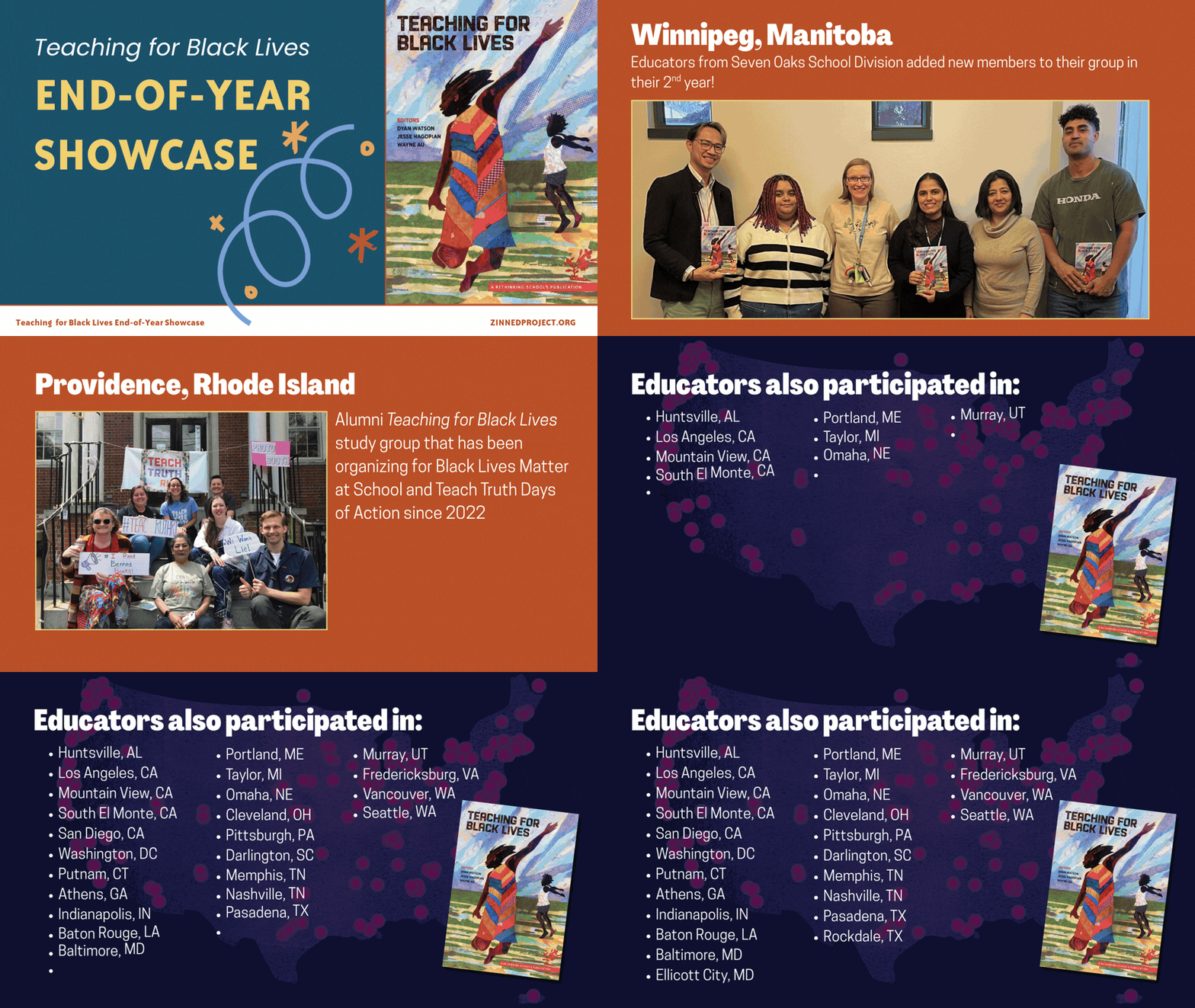
Participants said:
- I was really inspired by Dr. Bettina Love! I really appreciated thinking about the idea of collective action and how she framed it.
- My biggest gain from today’s section was a continued sense of community with incredible people who are dedicated to making a change.
- We must continue doing the work because NOW is the time! “What will we do to create in this moment of regression?”
- I loved hearing from Dr. Love. So much of what she said resonated with me — and I can’t wait to read her books. That was an amazing way to open the celebration!
- Inspiration and encouragement. Dr. Love’s words are always timely, and her orientation toward this moment as exactly the moment for this week (“Progress is on the other side of this — let’s GO!’) helps anchor and fuel me in this work.
- It was powerful how each group approached this opportunity to build thoughtful and engaging discussion. This reading group turned into so much action. I love how one group did a district showing Selma and an other group passed an ethic studies curriculum.
- It’s so good to be reminded that we are not alone in this struggle. Working towards change can be exhausting, and I’m so thankful to know that there are so many dedicated educators who are doing this work along side me, even if I don’t know them or talk to them all the time.
- It is amazing to see how far our collective reach is in this culminating event and to hear how much value the work that our study groups do is valued. I also am very impressed with Dr. Bettina Love how she reminded us that the work that we are doing in the struggle is meaningful and necessary.
- It really resonated with me when Bettina Love shared bell hooks quote, “If the work doesn’t leave you transformed, what’s the point?” This hit me and reminded me there is always work to be done, especially in community with others.
- Dr. Love’s comments about the importance of being truthful as educators really stuck out to me. I struggle with feeling like I can tell the truth in a red state with no union power, but it is really crucial to my students. I feel inspired to take the risk of having honest conversations that are in the best interest of my students.
- I really liked what my discussion group was able to reflect on for this year as a whole: we talked about how our groups ran this year, strides we were able to make, and also able to talk about some plans for the future/next year!