
A group of fellow elementary educators gather around a table laden with food, pulling up chairs, chatting, and passing around the snacks as they settle in. To begin their Teaching for Black Lives study group, they read their community agreements aloud — a ritual that reaffirms their shared commitment as anti-racist educators.
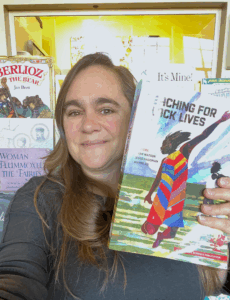
Sarae Pacetta
For Sarae Pacetta, an early childhood educator at Waynflete School (EC–12) in Portland, Maine, these monthly meetings have become a lifeline amid rising censorship laws: a space to think collectively, challenge assumptions, and put theory into practice. Pacetta coordinates her school’s study group, now in its fourth year.
Initially, one person emailed staff after learning about the opportunity, and the group was announced at a staff meeting before launching the following fall with four or five participants. From the start, they built a strong group culture, beginning each meeting with 15 minutes of food and informal connection, and rotating facilitation duties. They explore diverse materials, from book chapters to interviews and podcasts. They process learning through one-on-one conversations, journaling and silent written conversations on posters hung around the room. Now, the group includes educators from all grade bands, as well as specialists, tutors, and admissions staff.
 Some lessons emerge on a structural level. In the study group’s first year, the 4th- and 5th-grade teachers were planning a bus trip to Lowell, Massachusetts. After reading the Rethinking Schools article, “Fatphobia Showed Up in My Classroom,” they reflected on how student size can make sitting three across a seat uncomfortable every year. “The article had the 4th- and 5th-grade teachers that were in our study group reflecting on how every year there’s a really uncomfortable moment where there’s a kid or two that makes it so that three kids can’t sit in a seat,” Sarae explained.
Using insights from their discussion, the teachers submitted an official request for an extra bus, explaining why only two kids should be expected to share a seat. Although it required additional expense and logistics, they argued it was worth it to prevent discomfort and undue attention for students. The school agreed. This act of reflection and dialogue turned the group’s conversation into immediate, concrete change.
Other changes are more personal. For Sarae, the study group helped her gain confidence to openly address race, gender, and family structure in conversations with parents during conferences and other meetings:
In the last couple of years, there have been some genderqueer parents, some gay parents, some Black parents, and a couple multilingual families. At the beginning of the year, I named that I see this aspect of their families’ identity. Not expecting them to lead me or teach me, and also wanting to open the conversation so that I can be a partner for them and for their child’s experience at school.
While some families declined her invitation, others welcomed it. “[Some families] were so grateful that we had brought it up and said, ‘This is actually super important to us. We’re really worried about being one of only two Black kids in this group of 32, and we would like to tell you what we want for our kids’ experience vis-a-vis race.’” Over time, Sarae says, these conversations fostered trust and built partnerships that enriched students’ classroom experiences.
Networks like these form a bulwark against efforts to silence honest teaching about history, identity, and race. They build community power and nurture anti-racist coalitions that enable educators to drive systemic change. Teaching for Black Lives study groups are more than a program or a book. They are the infrastructure needed to sustain the movement for truthful, justice-centered teaching.
This snapshot is based on a interview with Sarae Pacetta by Jey Ehernhalt in February of 2026.